


 The unit used to establish the purity of gold is the carat.
Pure gold is called "24 carats" and when a piece is said to be 18 carat gold, it means that in its composition there are 18 parts of pure gold and 6 parts of other metals. 18 out of 24 is the percentage of pure gold in the final alloy.
To understand why the number 24 is taken as a reference, one must go back to the monetary system of ancient Rome, which was duodecimal and contained numerous equivalences in ratio 24. This is the detailed history: The Roman pound (327.45 g) was divided into 12 ounces; each ounce, into 2 half-ounces; each half-ounce, into 12 scruples; and each scruple, into 6 siliques. Thus, a pound equaled 1728 siliques.
At the beginning of the 4th century AD, Emperor Constantine the Great established a new currency: The Gold Solidus, which remained in use until the 10th century and weighed 4.54 grams, 1/72 of a pound, equivalent to 24 siliques. And it is this last proportion that we are interested in remembering.
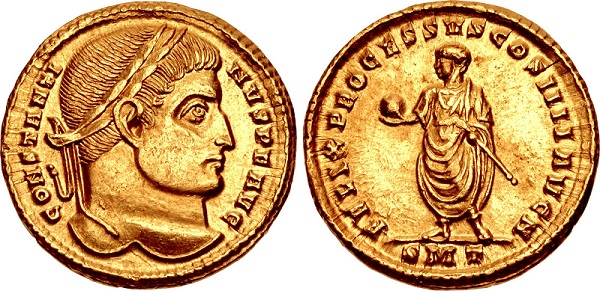 "Solidus aureus" issued by Constantine the Great
The Roman siliqua was taken from the Greek system, but they did not call it siliqua, but rather keration and if we divide the weight of the Roman pound by the 1728 siliques it equaled, it gives us 0.189 g, the weight of the Greek keration (later called carat).
The Latin word siliqua, generically means 'pod', but specifically applied to that of the carob tree and is the Latin translation of the Greek keration, for the characteristic pod shape of carob pods.
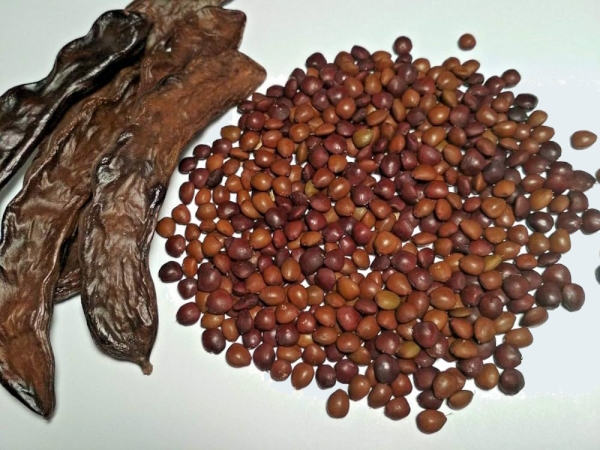 Pods of the carob tree - keration - carat
Although the Gold Solidus was a stable and trustworthy currency, it did not always contain the weight of the 24 siliques or carats of gold intended. In the 6th and 7th centuries, lighter specimens were minted, weighing 23, 22, and 20 carats, and sometimes, imperfect gold refining techniques resulted in coins that, despite having the correct weight, had a purity of less than 100%. Finally, throughout the 11th century, the Solidus was progressively devalued, until its disappearance: Initially they had a purity close to 90%, but by the end of the century, almost half of the coin's metal was no longer gold.
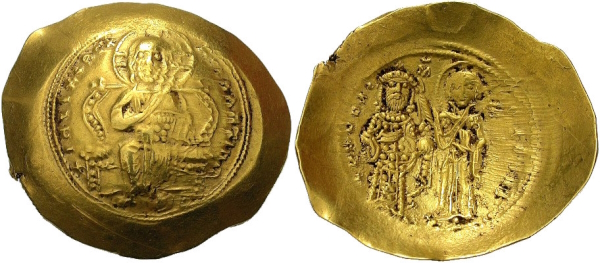 Solidus (called in Greek "Histamenon nomisma") minted under the Byzantine Emperor Constantine X with concave mold.
To determine the real value of the coin, an objective unit of purity was needed, and this was deduced from the carat: It was about knowing which part of the 24 carats that the piece weighed were of pure gold. The Byzantine Emperor Constantine X issued solidi with only three-quarters of pure gold, that is, with 18 carats of gold and 6 of other metals. Its purity was therefore, 18 out of every 24 carats.
And that is how modern jewelry continues to measure the purity of gold alloys, although increasingly the measure in thousandths is used (with the pure metal being "of 1000 thousandths"), based on the discreet uniformity of carob seeds, although this relationship is becoming forgotten. By the way, the scientific name of the carob tree is Ceratonia siliqua..., and from the word Solidus we have taken the word "salary", but that is another story...
It is important not to confuse the carat as a measure of weight with the carat as a measure of gold purity. In another article, we analyzed the differences.
Both on our website and in our physical store -dedicated exclusively to engagement jewelry and wedding bands- we showcase a wide range of models crafted from gold, platinum, carbon, titanium, steel, tantalum, zirconium, silver, and more.
Discover our models, featuring prices and key characteristics
Thank you for visiting us. For any additional inquiries, you can count on our team.


 Customer Service
